
-

Baumer
O300.GL-NV1T.72N
11171742
Diffuse Sensor, Background Suppression, Pulsed Red Laser Diode, Laser Class 1, 11-30VDC, 30-250mm Sensing Distance Tw, qTeach, NPN Complementary, Light/Dark Operate, M8 4-Pin Connector, 12.9 x 32.3 x 23mm (WxHxD), -10 to +60°C, IP67
$339.20$339.20 -

Baumer
OM70-L0250.HH0180.EK
11220168
High Performance Laser Distance Sensor, 50-250mm Measuring Distance Sd, 180mm Sweet Spot, OM70 Laser Line, Webserver, Ethernet TCP/IP, 15-28VDC, Analog and Digital, IP67, 74 x 26 x 55mm (HWD)
$3,818.80$3,818.80 -
 $289.69$289.69
-
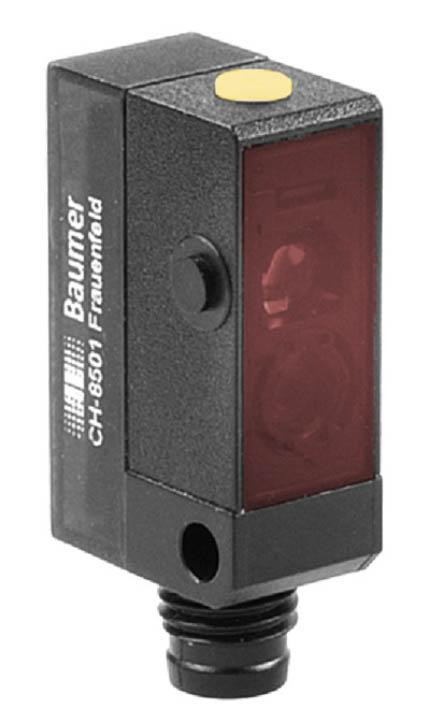
Baumer
FPDK 10N5135/S35A
11000897
Retroreflective Sensor, Miniature, Pulsed Red LED, 10-30VDC, 3.5m Actual Range Sb, 4m Nominal Range Sn, Potentiometer, 240°, NPN, Light/Dark Operate, M8 4-Pin Connector, 27 x 10.4 x 16.3mm (HWD), Plastic ASA Housing, PMMA Optics, -20° to +6
$253.20$253.20 -

Baumer
O300.TL-ZZZZ.72N
11176845
Thru-Beam Sensor, Emitter, Pulsed Red Laser Diode, Laser Class 1, 11-30VDC, 40m Actual Range Sb, M8 4-Pin Connector, 12.9 x 32.3 x 23mm (WxHxD), Plastic (ASA/PMMA), -10 to +60°C, IP67, Receiver Sold Separately
$249.20$249.20 -

Baumer
O200.GR.F-NV1Z.72CV/BX15
11210528
Miniature Photoelectric Diffuse Sensor with Background Suppression (BGS)
$204.89$204.89 -

Baumer
O200.ER-PV1Z.72NV
11212608
Miniature Photoelectric Thru-Beam Sensor, Receiver, 10-30VDC, 5m Range, Dark Operate, PNP Complementary, Push-Pull Smooth Sleeve M3 (Stainless Steel), 2m M8 4-Pin Flylead Connector, Plastic (ASA, PMMA) Housing, Rectangular 25.1 x 8 x 14.
$171.00$171.00 -

Baumer
O200.GP-GW1J.72CV/E022
11230663
Miniature Photoelectric Diffuse Sensor with Background Suppression (BGS)
$282.00$282.00 -

Baumer
O200.ZR-NV1T.72NV/E026_H006
11231268
Photoelectric Diffuse Sensor with Intensity Difference, Pulsed Red LED
$214.20$214.20 -
 $340.49$340.49
-

Baumer
O500.ER-GW1B.72CU
11167280
Thru-Beam Sensor, Receiver, 10-30VDC, 25m Actual Range Sb, Push-Pull, qTeach/Remote, Light/Dark Operate, 2m 4-Pin Cable, Plastic Housing, PMMA Front (Optics), 45 x 18 x 32mm (HWD), -25 to 60°C Operating Temperature, IP67
$125.20$125.20 -
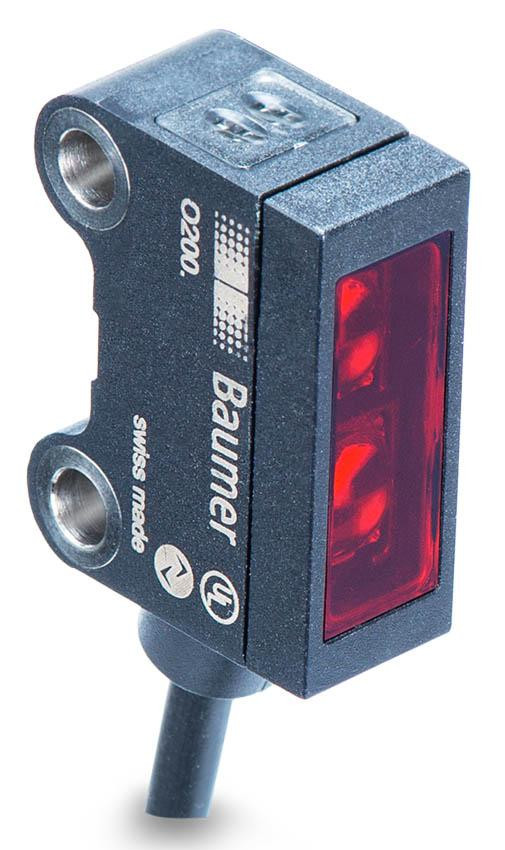 $221.89$221.89
Photoelectric sensors detect the distance, absence or presence of an object. These sensors are great for sensing long distances and detecting most materials.
Additional Sensor Categories:
Proximity | Ultrasonic | Pressure | Temperature | Level | Tilt
How Does a Photoelectric Sensor Work?
Generally a photoelectric sensor consists of the following:
- Transmitter - emits the light beam
- Receiver - detects the light beam and converts it to an electrical signal
Photoelectric sensors detect changes in the light beam caused by the presence/absence, movement or properties of an object.
Types of Photoelectric Sensors:
- Through-Beam (Thru-Beam)
- Transmitter and receiver are two separate units that are directly opposite of each other. The sensor detects when an objects breaks the light beam
- Great for long distance detection
- Ideal for conveyors, counting or monitoring door openings
- Retroreflective (Reflective Mode)
- Transmitter and receiver are in one housing; light beam is reflected back by a reflector. Detection is triggered when an object breaks the beam.
- Medium range detection and easier to install than a through beam
- Ideal for package detection and pallet positioning
- Diffuse (Proximity Mode)
- The transmitter and receiver in one housing; the sensor detects light reflected directly off the target object (no reflector needed)
- Best for short range applications
- Ideal for detecting objects on assembly lines, verifying presence or checking fill level
- Specialized Types:
- Background Suppression: Can ignore objects beyond a set distance, focuses close range
- Color or Contrast Sensors: Detects specific colors or contrast differences
- Distance Measuring Sensors: Mesaure the distance to an object
Categories Related to Photoelectric Sensors:
- Stack lights - signal towers visually communicate the data or alerts that the photoelectric sensors are generating
- Smart relays - photoelectric sensors provide input signals which can process the data and control outputs
- Pushbuttons and estops - if your sensor detects a fault, an operator can use a pushbutton to reset the system
- HMIs - HMIs can dispay the data from the photoelectric sensor which allows you to monitor processes